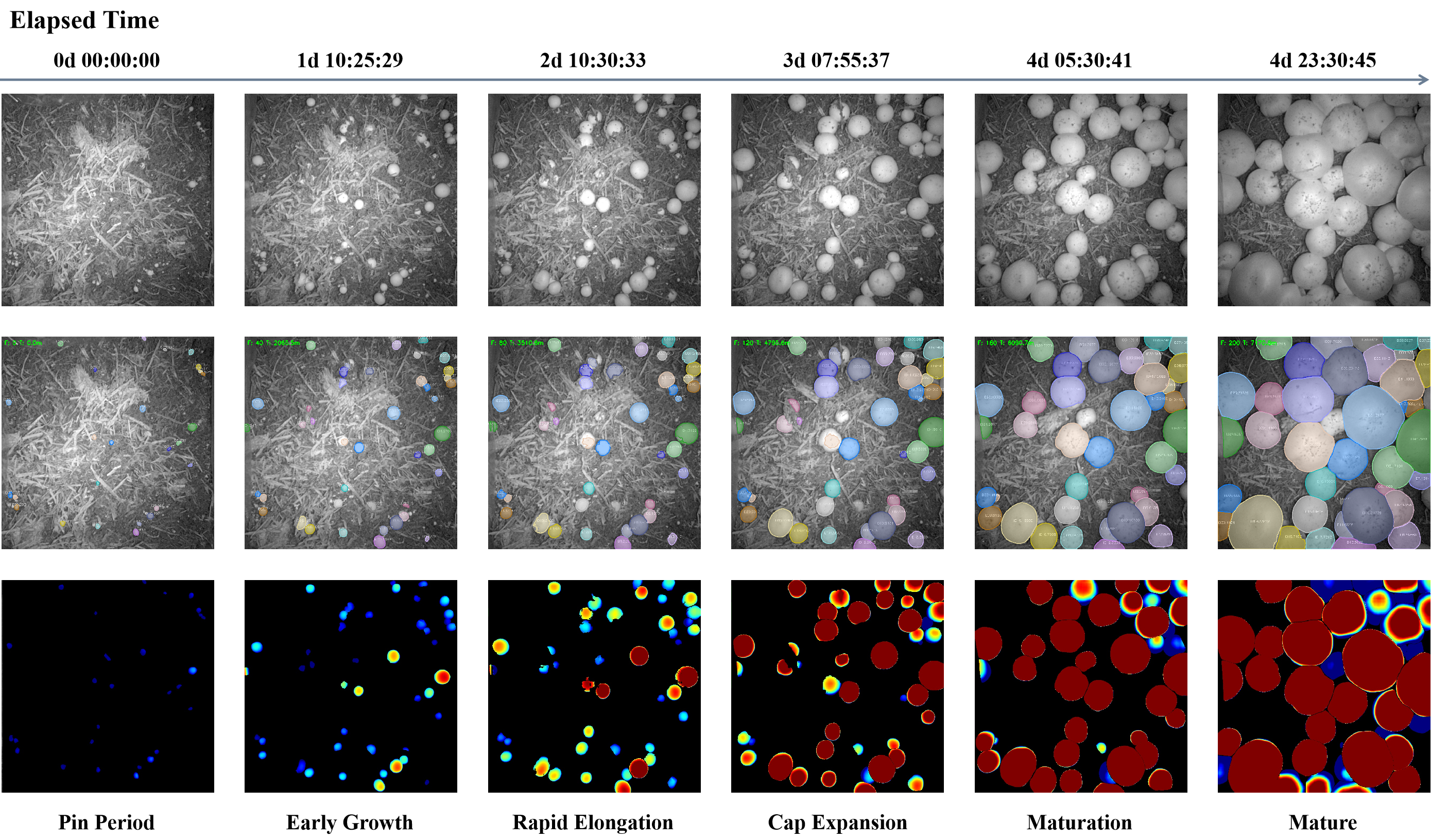
Figure 1: Time-series visualization of mushroom growth, instance segmentation, and depth estimation under infrared imaging. From top to bottom: raw infrared observations, segmentation results, and estimated depth maps across different growth stages.
A monocular infrared imaging system enables reliable mushroom observation in completely dark and humid cultivation environments.
A YOLO-assisted SAM2 framework provides accurate instance segmentation for dense mushroom clusters with precise boundary refinement.
An optimized MoGe2 model reconstructs dense depth maps from monocular infrared images, enabling 3D mushroom geometry estimation without multi-view sensors.
Continuous time-lapse observations allow quantitative analysis of mushroom growth dynamics, including height evolution and canopy expansion.
Figure 1: Time-series visualization of mushroom growth, instance segmentation, and depth estimation under infrared imaging. From top to bottom: raw infrared observations, segmentation results, and estimated depth maps across different growth stages.
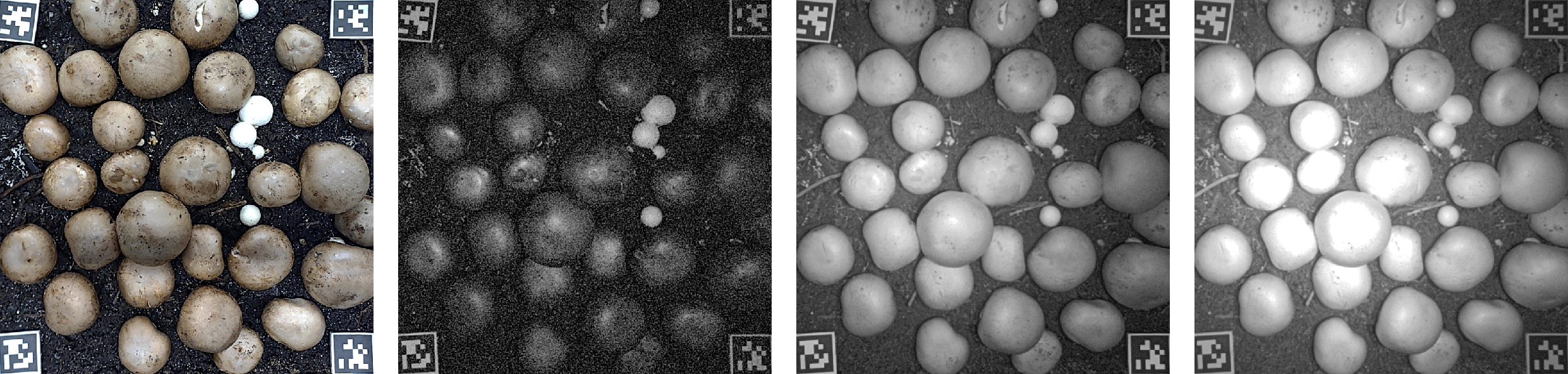
Figure 2: Comparison of mushroom imaging under different lighting conditions, including normal RGB illumination, dark-environment RGB, infrared imaging with 20% IR intensity, and infrared imaging with 100% IR intensity.
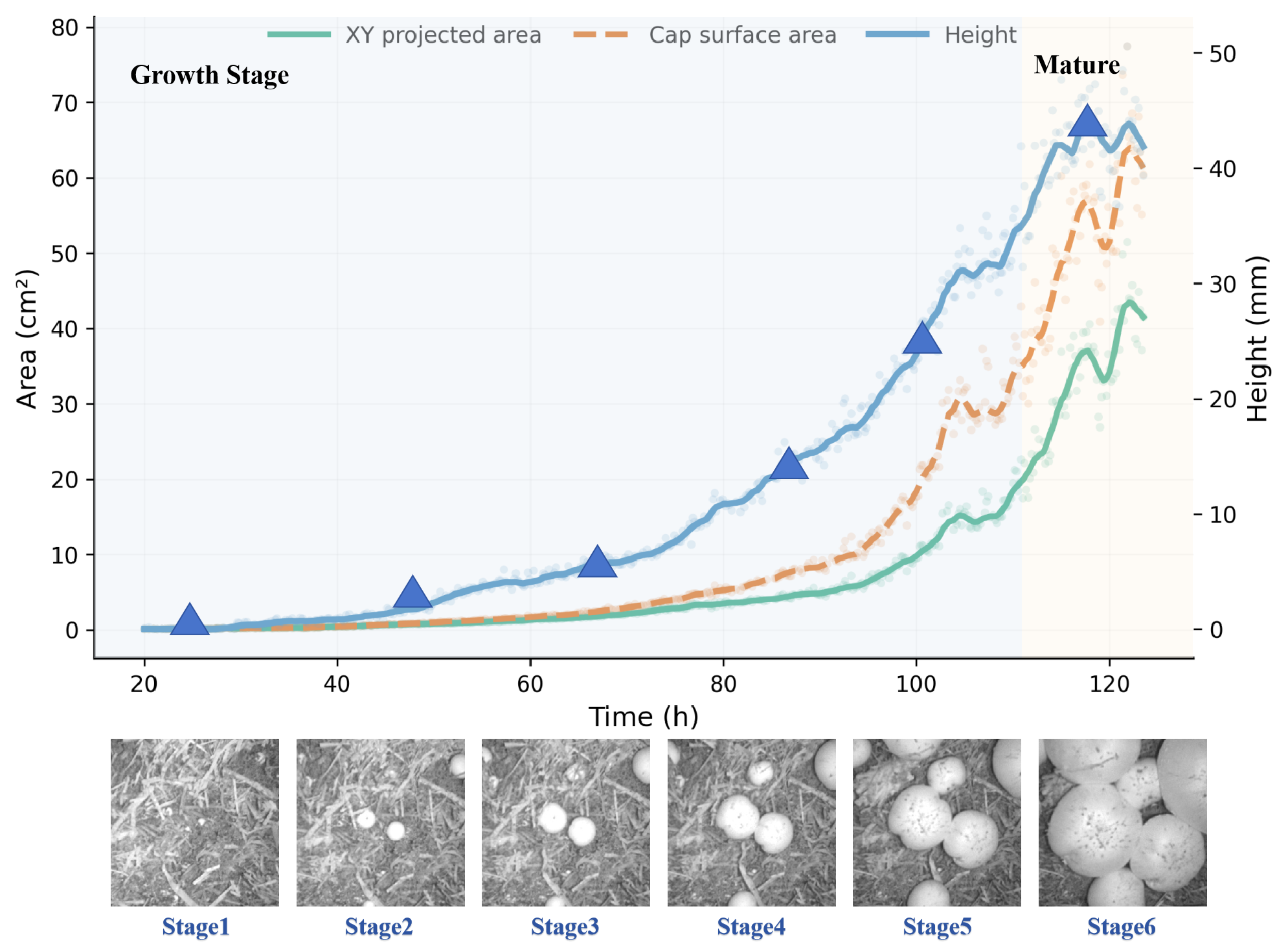
Figure 3: Time-series growth analysis of a single mushroom, showing the evolution of projected area, cap surface area, and height across developmental stages.
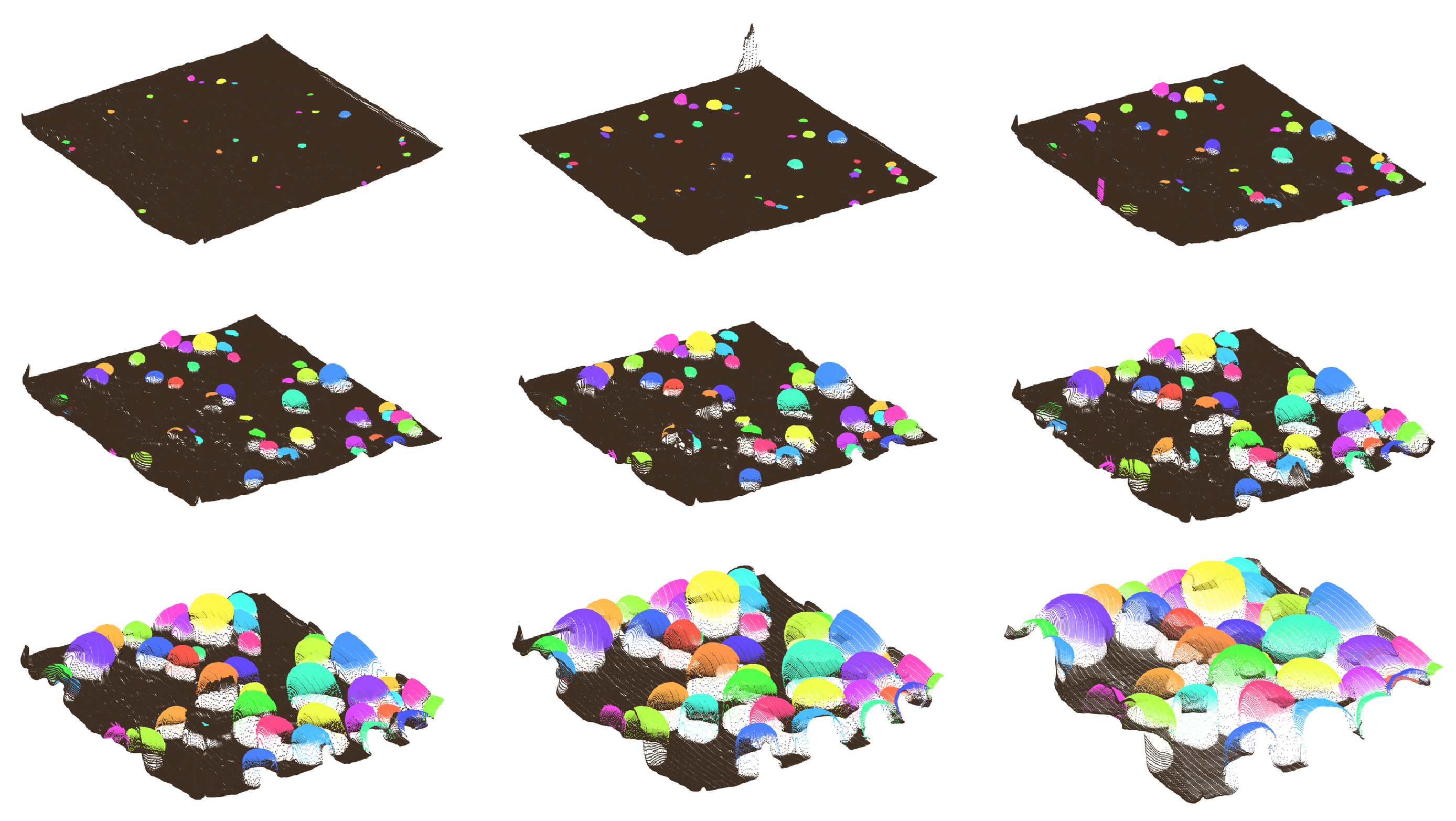
Figure 4: Visualization of 3D reconstruction results for a mushroom cultivation scene across different growth stages. Colored mushroom surfaces indicate individual segmented instances reconstructed from monocular infrared geometry estimation.
Preliminary experiments demonstrate that the proposed framework enables reliable mushroom phenotyping in dark cultivation environments using monocular infrared imaging. The YOLO-assisted SAM2 segmentation framework produces precise instance masks for densely clustered mushrooms, while the optimized MoGe2 model provides accurate depth estimation from single-view infrared images.
By integrating segmentation and geometry estimation, the system can automatically extract mushroom height and canopy expansion over time, enabling quantitative analysis of growth dynamics. The results suggest that monocular infrared geometry estimation offers a practical and scalable approach for automated mushroom monitoring in real-world agricultural environments.